
not true or false, but a secret third thing
where we learn about Quantum Computing

Today I am going to try and explain the complicated world of Quantum Computers, which are incredible, epoch-altering machines that every single person should be invested in.
First, I should explain how computers work at a base level.
Traditional computers use what is called Boolean Logic. The name comes from this guy…
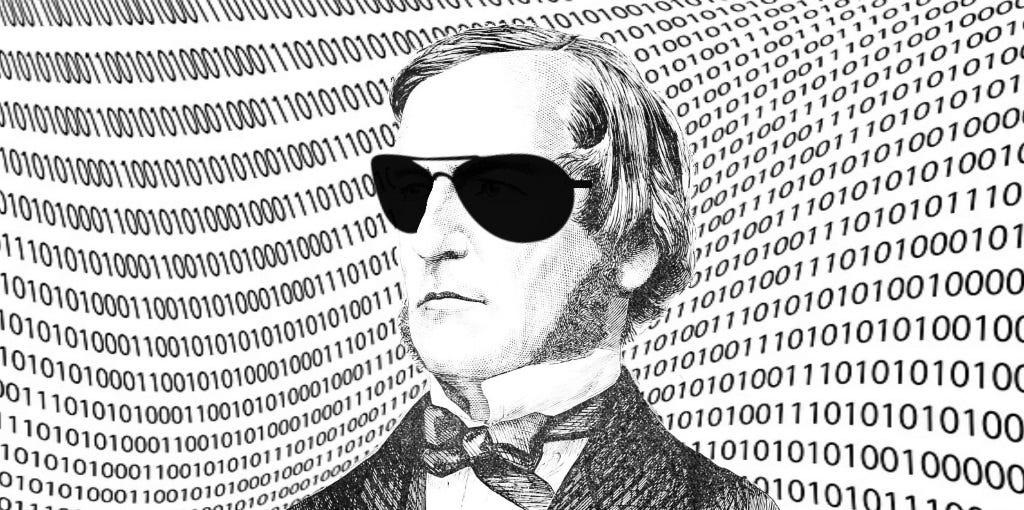
...who created the idea in 1847 which is a pretty long time ago.
Boolean Logic is a form of algebra which states that everything is either TRUE or FALSE. So, when we take this and apply it to binary computing, it means that everything is either 1 or 0. The millions of transistors and capacitors at the heart of computers can only be in one state at any point. Each bit in a computer is either 1 or 0. That’s what bit stands for. Binary-Digit. Computers can do remarkable things, from display a simple image to run insane graphical videogames. But when you boil it down, it’s all just 1 or 0 processed millions and billions of times. It’s a remarkable feat and worth thinking about when you are typing, or listening to music, or watching porn. It’s all binary.
It’s also a bit shit when you compare it to Quantum Computing.
Quantum Computing is exactly what it says – it’s computing that relies on the principles of Quantum Mechanics. It was posited as a theory in 1981 by a guy called Paul Benioff...

...then in 1984 David Deutsch began to work out the principles while at Oxford University.
Unlike standard computers, Quantum Computers uses particles such as electrons or photons. Each particle is called a Qubit. These qubits don’t just have to be 1 or 0. They can be both. This is because of something heinously complicated called superposition which I will try to explain below.
Superposition in terms of computing means this. You have your Qubit. It has a charge assigned to it. Either 1 or 0. Same as with binary. But! Because the Qubit has an electromagnetic field, it spins. So, when you blast it with an energy source – let’s say a laser – you can change its spin. Blast it with half power, and you change it from up or down to both. It can take on properties of both 1 and 0.
But what does this mean for computers?
Well in the most basic term possible it means this – instead of something being Yes or No, it can now be Yes and No. Or Kinda. Or Maybe a Little.
Obviously this means computers will be more powerful. But how much more powerful?
Quite a lot! A basic Quantum Computer would be 158,000,000 times quicker than the most advanced super-computer we have today. Put another way, it could accomplish in four minutes what it would take a supercomputer 10,000 years to achieve. You know Deep Thought? The supercomputer in Hitchhikers Guide to the Galaxy that took 7.5 million years to work out the meaning of life, only for it to turn out to be the number 42? A quantum computer would have worked that out in less than 3 minutes!

You’ll notice a lot of would and could in the passage above. That’s because as it stands Quantum Computers are fucking useless. Qubits exist, and we know they work. But they are also incredibly sensitive to things like dust and temperature. And because of the way the system as a whole is linked, once one Qubit gets upset and destroys itself, they all start kicking off. Scientists have operated these Qubits for about a minute before they suffer from what’s known as decoherence which is a fancy word for losing it’s information which means it can’t coherently exist in a system.
Another issue with Quantum Computers is how often they need to be fixed. It’s ALL THE FUCKING TIME, and because of the nature of Quantum Mechanics you can’t just hit it with a hammer. No, you have to throw in Quantum Information in order to reach something called an entangled state.
All this is to say Quantum Computers are amazing machines that don’t work.
But when they do work, oooooooh boy! They will change everything. We’re not talking faster internet or smaller machines here. We’re talking a complete upgrade on everything, from Chemistry to Geology, from simulations to experimental data. Imagine you are a scientist who has dedicated 70 years of his life (he’s old) to working out one specific question. Now imagine he could have done it in 0.5 seconds.
As a species, we should embrace Quantum Computing. When it comes (and it is when, not if – read this article if you want to see how close we are) it will revolutionize the human race. Will it come soon enough to reverse the devastating effect we are having on our world? Maybe. And it would offer real solutions, almost instantly.
Thanks for reading - I have just moved house and need cool posters for my office so if you have a dollar, please consider donating it to my ko-fi.
ko-fi.com/stuartbuck